Glimpse PoW
PEFT
Introduction Parameter-efficient fine-tuning is particularly used in the context of large-scale pre-trained models (such as in NLP), to adapt that pre-trained model to a new task without drastically increasing the number of parameters. The challenge is this: modern pre-trained models (like BERT, GPT, T5, etc.) contain hundreds of millions, if no... Read more 27 Feb 2025 - 8 minute read
VAEs
Introduction Autoencoders are a class of neural networks primarily used for unsupervised learning and dimensionality reduction. The fundamental idea behind autoencoders is to encode input data into a lower-dimensional representation and then decode it back to the original data, aiming to minimize the reconstruction error. They are also used for ... Read more 26 Feb 2025 - 7 minute read
GANs
Introduction Generative Adversarial Networks (GANs) are a class of deep learning models introduced by Ian Goodfellow and his colleagues in 2014. The core idea behind GANs is to train a generator network to produce data that is indistinguishable from real data, while simultaneously training a discriminator network to differentiate between real an... Read more 26 Feb 2025 - 3 minute read
CLIP
Architecture Contrastive Language-Image Pre-training (CLIP) uses a dual-encoder architecture to map images and text into a shared latent space. It works by jointly training two encoders. One encoder for images (Vision Transformer) and one for text (Transformer-based language model). Image Encoder: The image encoder extracts salient features fr... Read more 26 Feb 2025 - 2 minute read
NerFs
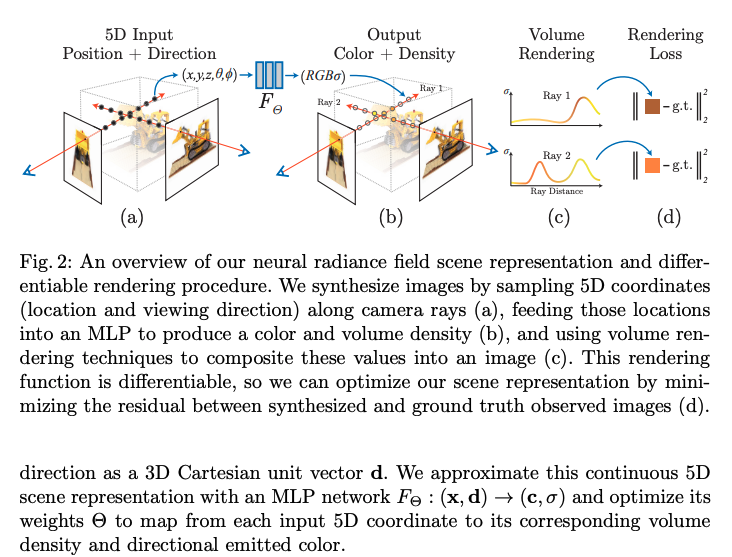
Pytorch implemntation from scratch Introduction Neural Radiance Fields are a way of storing a 3D scene within a neural network. This way of storing and representing a scene is often called an implicit representation, since the scene parameters are fully represented by the underlying Multi-Layer Perceptron (MLP). (As compared to an explicit repr... Read more 17 Feb 2025 - 2 minute read